Monday, October 31, 2011

Notes from day 1 of KohaCon11 in Thane, India.

I am in India !
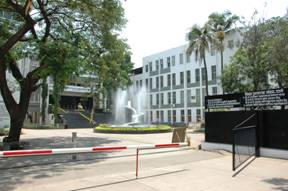
India has long been on my bucket list of places to see before I die - and here I am! The Koha community has gathered in Thane, Mumbai as guests of VPN Thane. There are around 120-150 of us and from a number of different countries.

Opening session:
Dr VJ Bedekar

What an amazing man! Clearly has a deep understanding and commitment to open source. Dr Bedekar has extended every hospitality to us; even making his personal car available to collect us each day from the hotel. Really, there is nothing more that could have been done to make us feel welcome and our stay here successful.

I delivered the keynote address next, slides and text of my presentation here. It went quite well I think. I wanted to stress the importance of vendors and libraries and end users and developers all working together to make good software and the simple rules to keep the community working together well: trust, share, grow (and don't be a dick).

The Principal, Dr (Mrs) Shakuntala Singh is so warm and gracious and intelligent and talented. We have been told that she was a champion badminton player, an accomplished musician and has a PhD in Philosophy. She has spoken with conference attendees several times and is clearly held in high regard by her staff.

Paul Poulain (the only person to have attended every KohaCon) reminded us all of the history of the Koha project. What I have noticed is that the Koha Community has stopped pretending to care about LibLime: "They are on their island and we are on ours". This is a healthy step and allows us to continue developing great software without the distraction of a LibLime circus on the sidelines.

Vijay Rahene presented a paper which reminded me of the important role librarians have in teaching new technologies so that our library members can access information - which now increasingly resides online and not on paper.

I love good orators and Awoyemi Akinade is such a man. Terrific message delivered in a passionate and engaging manner. Talked about how African scientists need open access in order to join the global scientific community. Copyright and access is part of problem: "the big business of copyright." Costs money to access this stuff - too much money but you also have to pay and its impossible to pay if can't access creditcards.

Access was one strand of his talk, but also publishing. We need to redress the imbalance of Nigerian / third world publishing particularly scientific research and findings. Indexing was the 3rd aspect he covered. Lots of stuff is published in Nigeria, paper and pixels, but is not indexed and findable via online methods. The internet is overwhelmingly US, English-speaking and western-focused. My takeaway from Akinade: Africa's scientists have much to offer, but the problem is access to western data and places to publish their work. We need an open source, open access repository for scientfic publication.

Next up was Brooke Johnson, looking stunning in a heavily embroidered sari. She talked about introducing lots of gaming tricks and devices into Koha to make it more 'friendly' and rewarding ... much like a computer game. Very stimulating session and lots of great ideas. Slides here.

Sadhir Badhe delivered a paper on Koha in Indian Public Libraries and talked off the challanges to automation: people are actually your biggest problem and their aversion to change. This relates directly to commenst made by 2 very concerned librarians at the end of 2 days of solid education. They asked 'but how do we print out the book cards". They couldn't quite understand that you don't run a manual system when you have an automated one. Marijana from Croatia had the same experience there, and Koustubha gave up saying no and just printed out cards for his library... so interesting.

Robin Sheat
gave a very good talk on the importance of 'keeping up' as in on the main development trunk of Koha. His graphical illustration of the forks and trunks etc made it so clear. We really must get up to 3.6 asap. His slides are here.

Dr Bedekar rounded off the day with good summary. Full Unicode support is ABSOLUTELY CRITICAL in an international context. Sometimes, in the US, we forget that. I couldn't agree more.

One final thing: KohaCon11 was written up in the local newspaper.

Monday, September 12, 2011

Warm fuzzies

It doesn't take much to keep me motivated in my work and today I was floating on Cloud 9.

One of our regulars is a lovely IHC client who calls me Flossy. She is about 55 and has a mental age of about 8. She loves Fairy books and we keep an eye out for new titles to give her when she comes in.

Today she was waiting outside the library at opening time, and entered beside me as part of the official party for the opening of our Pasifika Festival. After the formalities and the Kava Ceremony and an hour spent making a Samoan flower garland for her hair (with a hot glue gun!) she came and gave me a huge hug and said "Thanks for making our library so lovely".

That why I am a public librarian :)

Thursday, September 1, 2011

Thing 7 : Face to Face Networks and Professional Organisations

This weeks topic is professional organisations and I need to consider my experiences with them. What involvement have I had? How has it affected my career? What have I learned? Why are/aren’t I a member?

I first joined LIANZA when I was a student back in 1989 or so. I loved reading Library Life, the professional magazine, but once I had to renew as a full priced member I dropped it because I felt it was just too expensive. I did not resurrect my LIANZA membership again until I had to as part of the professional registration system which was introduced 3 or 4 years ago.

I gained my old-school library qualification from Wellington Teachers College back in the late 80s. It was an extremely practical qualification and graduates were really useful employees because they could actually 'do' the work rather than talk about it. I had experience with 2 university-qualified librarians and neither of them were much chop tending to get lost in intricacies and irrelevancies but couldn't even catalogue a book or cope with snotty-nosed, poor white-trash kids climbing on their knee for a cuddle at storytime. For a small town public library they were hopelessly out of their depth. Anyway, I digress ... as I do ....

I had been consciously building a strong CV for at least 5 years before the LIANZA Professional Registration Scheme came out; very deliberately upskilling myself knowing that my then boss would be retiring in the near future. I have been in this same job since I was 21. I came as an untrained, silly girl and worked my way up the ranks, first as a junior library assistant, then cataloguer, Deputy Head of Libraries and now Boss Lady. I gained my library qualification, then a degree with handpicked papers for this job, including modern English, feminist and post colonial lit, NZ and Pacific history and politics, management and journalism. Then I did a 1 year part time course on Linux, and then a 3 year part time course in Network Administration. I knew that when Rosalie retired I would have to face change. That could include applying for her job; knowing I would have to be much, much better than any other applicant to get the job because I had been here so long. The other option would be to apply for a job somewhere else and for that I would also need a brillliant CV to overcome what appears to be a sluggish, unambitious attitude to my career (by staying with one organisation my entire adult life).

All that by way of explaining that I needed Professional Registration to acknowledge my value as a librarian because my library qualification was practically worthless and so that is the only reason I rejoined LIANZA.


I occasionally attend local LIANZA gatherings: AGMS, Mid Winter dos etc. I always enjoy these gatherings immensely; the librarians are bright, bubbly, inspirational, clever, generous .... I do like Librarians as a general rule.

I have never become an office holder and at some point I probably should but at this point I'm not totally confident that LIANZA has a clear idea of its role in relation to APLM, the Association of Public Library Managers, which formed 3 or 4 years ago. I think APLM has siphoned off a lot of 'energy' and expertise.

I used to consider the annual LIANZA Conference a 'must' to attend each year but I am more committed to attending the NDF conference now. The reason for this is that I find NDF stimulating and inspirational whereas LIANZA is often more 'look what we did'. NDF is all about digital collaborations between the GLAM sector: galleries, libraries, archives and museums
and I do believe that is the way we need to be moving. Both conferences are excellent networking opporunities and many librarians attend both but the inspirational, thought provoking, 'jaw dropping' nature of NDF suits me better.

I am thinking lately that I might like to join SOLGM because I am becoming convinced that we librarians need to find better ways to sell our stories to the Councils who fund us. We have to learn how to place our stories in the right framework and tell them with the right words.

Saturday, August 20, 2011

Thing 6: online networks

Linked In
I have had a Linked In profile for a while now. The recommended reading by Sharlyn Lauby was very good. I went back and reviewed my profile. It is basically pretty good: professional photo, fairly explicit introduction to my work experience and interests, I have 3 referee statements and around 100 connections, none of whom I am embarrassed of :) I have never bothered with groups before but after looking at the examples I see they do add weight to a profile. Reminds me of Mum saying: "you are judged by who you associate with". I have my Slideshare account linked to my Linkedin which means that several of my slides from presentations can be viewed. I am careful what presentations I have saved online as I am aware they show on both sites. I never update my profile which I will have to address. I don't feed my Twitter comments here because I am pretty lighthearted and irreverent on Twitter sometimes ... and I like that tweets can't be found after 3 weeks or so - not so with LinkedIn.

Facebook
I have had a facebook account in the past; I was a reasonably early adopter well ahead of my kids who were still using bebo. However I cancelled it about a year ago for a number of reasons:
  • I got sick to death of the way facebook kept changing their approach to privacy,
  • I used facebook for my family only - and I explicitly stated that on my profile but still received dozens of requests from colleagues and vague associates wanting to be my friend (I hated saying no),
  • I allowed myself to get bullied into friending my kids and their mates and accepting their invitations to Mafia Wars, Farmtown etc and then ...
  • I got hooked into stupid online games (farming)
  • sick of stupid updates from friends about game, quizzes etc.
I actually find Twitter my best professional networking tool - and I chat daily with colleagues all around the world.
I don't regret closing facebook at all except for relinquishing my account means I can never get jransom back again if I ever regret not having an account.

Thing 5 : Reflective Practice

The post on the cpd23 website for this Thing is very, very good. I need to do reflective writing more often for two reasons:
  • I know it is a useful way to 'unpack' recent events that have not gone so well and figure out what happened and how to avoid repeating mistakes,
  • I need to write my professional development journal for reregistration.
I am not going to reflect on this project yet. I have been away for weeks and weeks doing a big piece of writing for work and I need to catch up to Thing 11! BUt I know I have to start work on my journal in the next month.


Thing 4: Current awareness

Twitter
I am a Twitter addict ... just love it. Here are some of the reasons why:
  • It is not time consuming - I can pop in and catch up very quickly through a quick scan back to where I last read, or I can just search on @me and reply to any I need to,
  • or It can be a great time waster: I can 'chat' with people, join conversations, follow links and check out trending hashtags,
  • some TV programmes are great fun with a twitter hashtag open - the commentary can be as amusing as the tv show (eg My big fat gypsy wedding is hilarious with commentary),
  • Extremely useful and informative during natural disasters: Christchurch earthquakes #eqnz, snow storms last week #snowmageddon etc,
  • professional development: I get so many fabulous links from Twitter; its like having my personal reading list 'weeding' who filter out the best links for me.
RSS Feeds
Before Twitter there was Bloglines and I absolutely loved it. Every evening I would park up the couch with a kid each side watching tv and catch up on a bunch of posts from my favourite websites. Then Twitter came along and I fell out of the habit of reading Bloglines so religiously ... and then the announcement that Bloglines was closing. I sulkily transferred all my feeds to Google Reader and sadly it is just not the same. I have found it hard to get used to but I think I have just fallen into a new groove with Twitter.

http://lonewolflibrarian.wordpress.com
http://www.greatleadershipbydan.com/

I have grouped my feeds into lists and while I read my 'favourites' every day some lists back up for a week or two. My favourite blogs at the moment are:

Pushnote
This is a completely new tool for me. It doesn't like me to be honest though I have signed up and rated 1 or 2 sites to see how it works. I didn't post it to my twitter account because i hate it when people flood my stream with updates like this ie runkeeper, foursquare etc. I can't envisage a way that I can use this to add value to my life. If I find a good site I mark it in delicious,